Thousands of chains have launched and gone quiet since 2014. I/O Coin has
produced blocks without a single halt — no premine, no ICO, no relaunch.
The swap to Proof-of-Stake was written into the consensus code before launch and executed
live around block 24,400. Every block is still verifiable, by anyone, today.
We don't need to sell a chart. We show the chain's work.
Everything below can be checked. The source is public, the chain is public, and
where a number isn't published anywhere, this page says so instead of inventing one.
Layer 1
I/O Coin is our own chain, not a token. IOC is the native coin of the chain it
secures — there is no parent network issuing it, no smart contract minting it and no
bridge it depends on to exist. Our own nodes, our own consensus, our own ledger, running
since 2014.
Nobody got a head start
No premine. No ICO. No founder allocation. The two-week mining period ran on PoW-X11,
chosen because it was video-card resistant — that made insta-mining very hard, so no
one could sit on a farm and take the supply before anyone else showed up.
Mining stops at 12,815
That number was in the launch rules, not a decision made later. The chain hit it around
height 24,400 and every node has rejected mined blocks since. No fork. No relaunch.
Still running
Blocks since July 2014, without a break. We don't say "100% uptime" because that's a
marketing number. The chain has never halted. Check an explorer.
Block budget
4 MB
Heavy-load gate
~16 s confirmations
Record payload
1 MB
Runtime
C++20
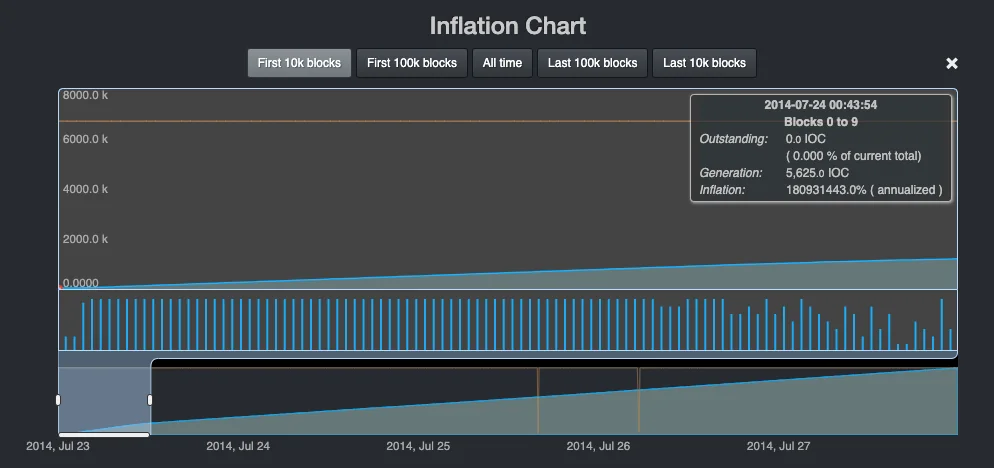
Public explorer, blocks 0–9. At genesis the chain held 0.00 IOC —
there was nothing to hand out, because nothing existed yet.
Ten days later · 2 August 201416,002,071 IOCmined under PoW-X11, then the curve goes flat
Every one of those coins was mined in the open during a two-week PoW-X11 mining period. At block 24,400 it stopped and stake took over. Both figures come from the public
chain, so neither has to be taken on trust.
What the chain does · DIONS
Names, messages and payloads, held by keys.
This is DIONS. Most chains move coins and leave names, messaging and
storage to whatever gets built on top later — these went into the protocol itself, in
2014. The full system launched in 2017 and has run on mainnet from then to today.
DIONS 2.0 is the upgrade to it: the same chain, rewritten underneath.
2014IONS goes into the protocol2017DIONS launches in full2017 — presentLive on mainnet, no haltNextUpgrading to DIONS 2.0
Names you own
An alias is an account with a readable name, resolved on the chain. No registrar, no renewal
invoice, no company that can take it back.
Messages nobody else reads
Direct messages and channels, encrypted under AES-256 before they are published. Holding the
key is the only way in.
Up to 1 MB a record
Files and payloads ride with the record. The content stays private; the hash is public, so
anyone can verify a claim without reading what it refers to.
Two ways to earn
Stake and produce blocks, or relay and earn from a zero balance with headers only. There is
no minimum stake in consensus — small stakes just win less often.
The upgrade
DIONS 2.0, and exactly what it claims.
A full rewrite of the node in C++20. Stake still produces the blocks. Everything
new sits behind an activation gate, which means it switches on at a set block height rather
than shipping live on day one.
Status labels mirror the source: In code is implemented,
Testnet runs on the public testnet, Not claimed is a target or dormant.
Mainnet has not launched.
For organisations
Records that outlive the company that made them.
Most enterprise data sits on a server somebody owns. If that vendor folds, loses
the contract or gets bought, the record goes with it. A chain that carries the data itself
removes that dependency — and this one has been carrying it since 2017.
Built for regulated data
Record privacy was designed against HIPAA obligations for data at rest and in
transit, not against anyone looking for anonymous money. The design target was compliance.
An audit trail you don’t host
The hash is public and timestamped by the chain; the contents stay encrypted. An auditor
can confirm a record existed and has not changed without ever reading it.
Identity for people, devices and agents
Aliases bind keys to readable names today. In DIONS 2.0 the same records bind to
autonomous agents and hardware through W3C DID-direction records.
Messaging with no server in the middle
AES-256 before anything is published, with direct messages, channels and file
transfer up to 1 MB a record. Nothing routes through a mail host you have to trust.
No licence, no seat count, no vendor
The node is open source and the chain is public. Running it costs what the hardware costs.
There is nothing to renew annually and nobody who can switch you off.
A ledger that has not stopped
Blocks since July 2014 with no halt, no relaunch and no chain reset. For a record that has
to still be checkable in a decade, continuity is the product.
Everything above runs on mainnet today under DIONS. DIONS 2.0 is on
public testnet and has not launched on mainnet — where this page describes a 2.0
capability, it says so. Talk to the Foundation at
iodigital.io.
The engineering record
Eleven years, decision by decision.
Sixteen moments where a real choice carried a real cost. Taken together they
are the reason the chain is still producing blocks on its original ledger.
The Foundation
What it set out to prove — and what it proved.
Twelve days after genesis the team published three goals. Most projects quietly
drop the early roadmap; all three of these shipped. The harder proof came after: that a chain
could carry the data itself, instead of pointing at a server holding it for you.
01
Get off Bitcoin-QT
A full HTML5 wallet with interchangeable skins — a first for a Proof-of-Stake coin.
Oct 2014
02
Build a name server
Readable aliases instead of address strings, shipped inside the wallet as IONS.
2014
03
Prove stake actually works
Blocks without a halt ever since, and the chains that followed took the same route.
since 2014
04
Carry the data on the chain
The record written into the ledger, not a hash pointing at somebody’s server.
2017
05
Encrypted messaging between keys
Messages, channels and file transfer, AES-256 before anything is published.
2017
06
Storage that travels with the record
Up to 1 MB each: content stays private, the hash stays public, the claim stays checkable.
2017
07
Privacy for regulated records
Stealth addressing aimed at HIPAA data obligations, not at anonymous money.
part, 2018–19
08
Listable without asking permission
gettxout gave decentralised exchanges what they need to settle against the chain.
Jan 2018
09
Identity for agents and devices
Aliases binding keys to names, agents and hardware through W3C DID-direction records.
DIONS 2.0
I/O Digital Research Foundation
The Foundation was set up in 2016 to curate the codebase, work with partners and
run community initiatives — including charity work such as mangrove preservation in
Indonesia. The project was recognised that year by Benzinga, the European Fintech 100 and
the KPMG Fintech 100. The codebase it curates is public, and every line can be read.
Three initiatives remain unfinished and the Foundation says so plainly: the DVM,
Nighthawk — around 90% complete, deliberately held so DIONS 2.0 ships first — and
Chameleon, announced at the North American Bitcoin Conference in January 2019.
Both are full nodes and both stake. The difference is how much of the chain you
want to deal with.
Start here
Widget Wallet
0.1.1-RC10 · 22 June 2026
Installs iocoind and runs it for you in the background. You get balance,
send and receive, staking and an address book — and legacy sync is far quicker than the
old client. The RPC port stays on localhost, so nothing is reachable from outside.
Best if you want to hold, stake and send
Node managed for you, nothing to configure
Faster sync, handled on its own — no bootstrap needed
Full feature set
DIONS Aurora
The original desktop wallet
The complete client, with the DIONS surface the Widget Wallet does not expose: aliases,
encrypted messaging, data records and file transfer. Heavier, and a first sync takes
longer unless you use the bootstrap package.
Best if you need aliases, messaging or records
Full DIONS feature set
Bootstrap data available to shorten sync
The archive
Written down as it happened.
Ten years of development notes, community letters and post-mortems — published
at the time, not reconstructed later. They are the source for most of this page.